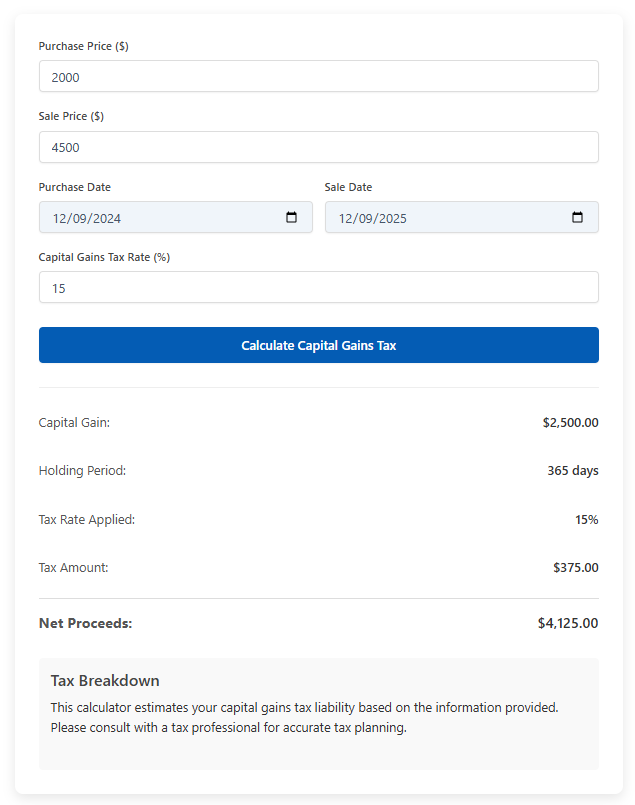
How much is Capital Gains Tax: Your Guide to Accurate 2025 Estimates & Smart Strategies
Navigating capital gains taxes can significantly impact your investment returns. Whether you’re selling stocks, real estate, or business assets, understanding your potential tax liability is the key to maximizing your profits. This comprehensive guide, paired with a powerful how much is capital gains tax calculator, provides everything you need to make informed decisions and explore legal strategies to minimize your tax burden.
Key Insight: The difference between short-term and long-term capital gains can be substantial. For a single filer with a $50,000 salary and a $15,000 investment profit, holding the asset for over one year could reduce the federal tax on that gain from 22% to 15%, saving over $1,000.
 2024 & 2025 Capital Gains Tax Calculator Rates
 2024 & 2025 Capital Gains Tax Calculator Rates
How much is capital gains tax rate is determined by two primary factors: how long you held the asset and your taxable income and filing status. The rates below are crucial for accurate estimations.
Long-Term Capital Gains Tax Calculator Rates (Assets Held >1 Year)
Long-term gains benefit from significantly lower, preferential tax rates.
| Filing Status | 0% Rate Bracket (2024) | 0% Rate Bracket (2025) | 15% Rate Bracket (2024) | 15% Rate Bracket (2025) | 20% Rate Bracket (2024) | 20% Rate Bracket (2025) |
|---|---|---|---|---|---|---|
| Single | Up to $47,025 | Up to $48,350 | $47,026 – $518,900 | $48,351 – $533,400 | Over $518,900 | Over $533,400 |
| Married, Filing Jointly | Up to $94,050 | Up to $96,700 | $94,051 – $583,750 | $96,701 – $600,050 | Over $583,750 | Over $600,050 |
| Head of Household | Up to $63,000 | Up to $64,750 | $63,001 – $551,350 | $64,751 – $566,700 | Over $551,350 | Over $566,700 |
Rates apply to the 2024 tax year (filed in 2025) and the 2025 tax year (filed in 2026).
Short-Term Capital Gains Tax Calculator Rates (Assets Held ≤1 Year)
Short-term gains are taxed as ordinary income, which means they use the standard federal income tax brackets with rates ranging from 10% to 37%.
Calculate How much is Capital Gains Tax: A Step-by-Step Walkthrough
 Calculate How much is Capital Gains Tax: A Step-by-Step Walkthrough
A robust calculator automates complex math, but knowing what goes into it helps you plan. Here’s what you’ll typically input and how the calculation works.
Essential Inputs for an Accurate Estimate
Initial and Sale Value: Enter the purchase price (cost basis) and the final sale price of your asset.
Holding Period: Specify whether you owned the asset for more or less than one year. This is the key determinant of your tax rate.
Filing Status & Annual Income: Input your tax filing status (single, married, etc.) and your total taxable income from other sources (like wages). Your ordinary income fills up the lower tax brackets first, which then determines the rate applied to your capital gains.
Location: Don’t forget how much is state capital gains taxes. While nine states (like FL, TX, and NV) have no income tax, others like California tax capital gains at rates up to 13.3%.
Real Calculation Examples
Here’s how the math breaks down in two common scenarios using 2025 rates:
Example 1: Long-Term Gain for a Single Filer
Salary: $50,000
Long-Term Capital Gain: $15,000 (from stocks held for 2 years)
Total Taxable Income: $65,000
Calculation:
The $50,000 salary fills the entire 0% long-term bracket ($0-$48,350 for single filers).
The remaining $1,650 of salary and the entire $15,000 gain fall into the 15% long-term bracket.
Tax on the Gain: $15,000 x 15% = $2,250.
Example 2: Short-Term Gain for a Married Couple Filing Jointly
Salary: $150,000
Short-Term Capital Gain: $30,000 (from crypto held for 6 months)
Total Taxable Income: $180,000
Calculation:
Short-term gains are added to ordinary income. The $30,000 gain falls within the couple’s 22% income tax bracket.
Tax on the Gain: $30,000 x 22% = $6,600.
Advanced Factors & Additional Taxes
 Advanced Factors & Additional Taxes
High-income investors and real estate sellers must account for extra layers of taxation.
Net Investment Income Tax (NIIT): A 3.8% surtax may apply to investment income (including capital gains) if your Modified Adjusted Gross Income exceeds $200,000 (single) or $250,000 (married filing jointly).
Depreciation Recapture (Real Estate): For rental or business property, depreciation claimed during ownership is “recaptured” and taxed at a maximum rate of 25%, separate from the capital gains rate.
Alternative Minimum Tax (AMT): In some cases, especially with large gains or incentive stock options, you may need to calculate your tax under the AMT system, which has fewer deductions.
Top Strategies to Legally Minimize How much is Capital Gains Tax
 Top Strategies to Legally Minimize How much is Capital Gains Tax
 Beyond using a capital gains tax calculator to calculate how much is capital gains tax for planning, these proactive strategies can help you retain more of your profits.
Harvest Tax Losses: Sell underperforming investments at a loss to offset gains from winners. You can deduct up to $3,000 in net capital losses against ordinary income annually and carry forward excess losses.
Hold for the Long Term: Whenever possible, hold investments for over a year to qualify for the lower long-term rates. The tax savings can be dramatic.
Leverage Real Estate Exemptions & Deferrals:
Primary Home Sale: Exclude up to $250,000 ($500,000 if married filing jointly) of gain from the sale of your main home if you’ve lived there for 2 of the last 5 years.
1031 Like-Kind Exchange: Defer all capital gains taxes on investment or business property by reinvesting the sale proceeds into a “like-kind” property within strict timelines.
Invest in Tax-Advantaged Accounts: Grow investments in IRAs and 401(k)s to defer or eliminate taxes on capital gains and dividends.
Time Your Sales Strategically: If you anticipate being in a lower income bracket in the future (e.g., after retirement), consider deferring the sale of assets to pay a lower rate.
Comparing how much is Capital Gains Tax Minimization Strategies
| Strategy | Best For | Key Benefit | Complexity |
|---|---|---|---|
| Tax-Loss Harvesting | Investors with losing positions | Directly reduces current-year tax bill | Low |
| Holding >1 Year | All investors | Qualifies for lower tax brackets | Low |
| Primary Home Exclusion | Homeowners selling their residence | Up to $500k gain excluded from tax | Medium |
| 1031 Exchange | Real estate investors | Defers tax, preserves equity for reinvestment | High |
| Retirement Accounts | Long-term retirement savers | Tax-deferred or tax-free growth | Medium |
Reporting how much is Capital Gains Tax: Required Tax Forms
 Reporting how much is Capital Gains Tax: Required Tax Forms
When you file, you must report capital gains and losses to the IRS using specific forms:
Form 8949: Report details of each capital asset sale (dates, costs, proceeds).
Schedule D: Summarize your total capital gains and losses from all transactions.
Form 1040: Transfer the final net gain or loss amount to your main tax return.
Final Checklist Before You Sell
 Final Checklist Before You Sell
Use this quick list with your capital gains tax calculator to ensure you’re prepared:
I have accurately calculated my cost basis, including commissions and fees.
I have confirmed my holding period (over or under one year).
I’ve used my filing status and total taxable income for an accurate rate estimate.
I have factored in state taxes and the 3.8% NIIT if applicable.
For real estate, I have accounted for depreciation recapture.
I have reviewed tax-minimization strategies like loss harvesting or timing.
When to Consult a Professional
While a calculator provides an excellent estimate, consult a qualified tax advisor or financial planner if:
You have very large or complex gains.
You are considering a 1031 exchange or Opportunity Zone investment.
Your situation involves inherited assets, business sales, or the AMT.
Using a detailed capital gains tax calculator to calculate how much is capital gains tax is the first step toward intelligent tax planning. By understanding the rates, accurately estimating your liability, and implementing strategic moves, you can confidently make investment decisions that maximize your after-tax wealth.
For precise, personalized calculations based on your unique financial picture, be sure to use the integrated how much is Capital Gains Tax Calculator on this page.